
Hyperpigmentation Of the skin is due to the Excessive production of melanin. Discover the causes and effective treatments to limit the appearance of brown spots on your skin.
What is hyperpigmentation?
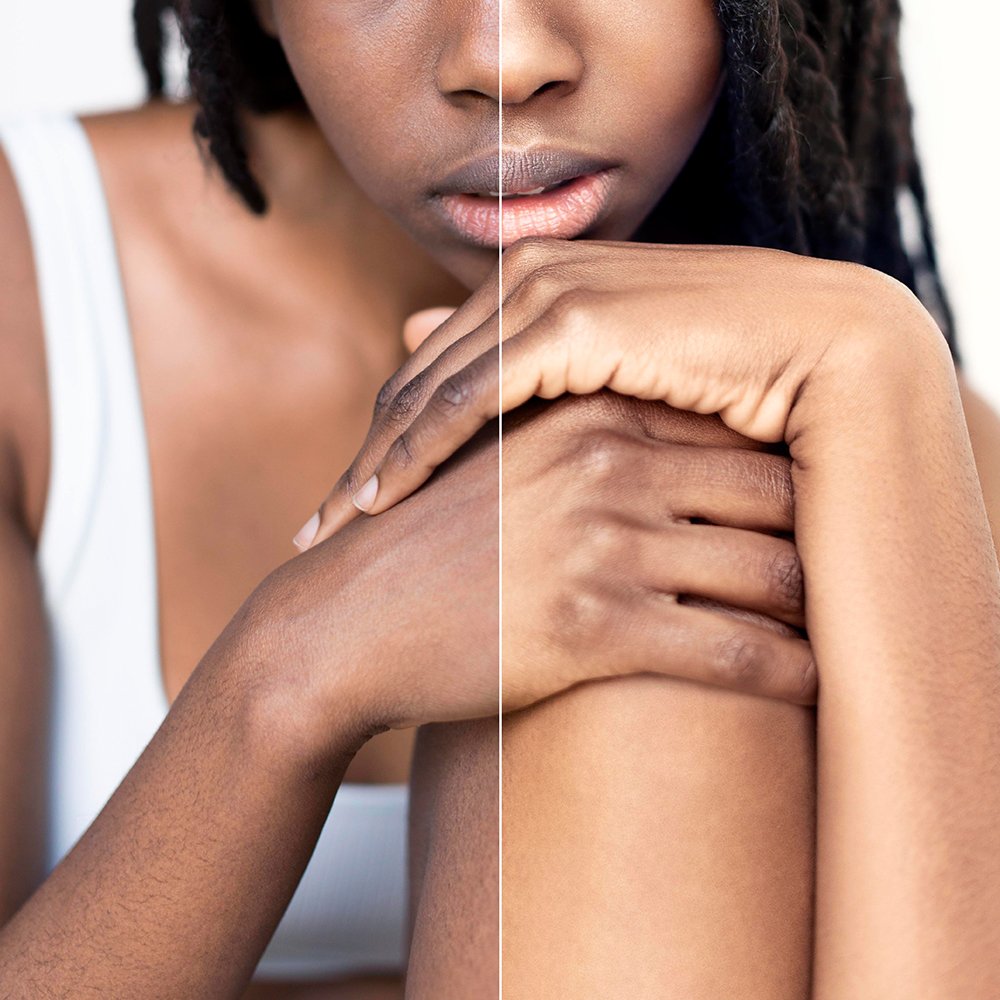
Hyperpigmentation is Skin darkening most often caused by abnormally high production of melanin. This Melanin is a natural dark brown pigment responsible for an individual's skin colour. Its role is essential as it protects the skin from ultraviolet rays. When melanin production becomes abnormal, skin pigmentation becomes uneven from one area to another, and dark spots appear on the body and/or face.
What are the Types of Hyperpigmentation?
Hyperpigmentation manifests itself through the appearance of brown spots on the skin, which vary in shape and size. There are different types of hyperpigmentation linked to multiple causes.. Various internal and external factors can explain the onset of hyperpigmentation.
Focal or Localised Hyperpigmentation: Of a post-inflammatory nature, focal hyperpigmentation – also known as localised hyperpigmentation – can occur following a lesion, a burn, or other instances of inflammation such as acne, contact eczema, or atopic dermatitis.
It appears as a patch with blurred and irregular contours, most often visible in the underarm area and on the back of the neck.
Diffuse or Widespread Hyperpigmentation: Diffuse hyperpigmentation, also referred to as widespread hyperpigmentation, results from medications and heavy metals, internal illnesses, or hormonal changes. Areas of hyperpigmentation can appear on any part of the body but primarily on the torso, abdomen, and face. The spots are symmetrical with an irregular contour but well-defined borders.
What are the Common Causes of Focal Hyperpigmentation?
Several factors can cause focal hyperpigmentation:
Lentiginosis (Freckles)
The term lentiginosis refers to Freckles, macules ovales plates de couleur beige à brune. Souvent dues à une exposition chronique au soleil, elles ne sont pas liées à un dysfonctionnement hépatique. Elles apparaissent principalement sur le dos des mains et le visage. Dans de rares cas, les taches de rousseur non solaire peuvent être associées à des troubles systémiques.
Melasma
This Melasma is caused by hormonal changes and it develops primarily in women during pregnancy or while taking oral contraceptives. It usually appears on the face as brown, hyperpigmented patches with irregular borders. It slowly fades after childbirth or after stopping hormonal medication.
Si le mélasma survient chez l’homme, il disparaît très rarement. L’exposition solaire augmente le risque de développer un mélasma.
Other Causes
Other causes like Skin lesionsreactions to the inflammationsreactions to the sun and Skin growths (Moles, melanomas) can be the cause of localised hyperpigmentation.
What are the Common Causes of Focal Hyperpigmentation?
Focal hyperpigmentation can be caused by:
Hormonal Changes
Hormonal changes can stimulate melanin production, causing it to increase, which then leads to a darkening of the skin. This is the case during pregnancy or when using hormonal contraception.
Cancers and other systemic diseases
Diffuse hyperpigmentation can be caused by systemic conditions or cancers, particularly lung cancer. The most common systemic diseases involved are Addison's disease, haemochromatosis, and primary biliary cholangitis (formerly known as primary biliary cirrhosis).
Medicamentations
Medications and heavy metals can also cause hyperpigmentation. The affected areas are often widespread across the body. These reactions typically fade after the triggering medication is discontinued.
What are the Risk Factors for Hyperpigmentation?
The Main Risk Factors for Hyperpigmentation Are:Sun exposure and inflammations.Indeed these two factors are responsible for increasing melanin production and, consequently, hyperpigmentation.
Other factors can also cause hyperpigmentation:
- Use of oral contraceptives
- Pregnancy
- Dark Skin Tone
- Taking Medications That Increase Sun Sensitivity
- Burns / Skin Lesions
How is Hyperpigmentation Diagnosed?
To diagnose hyperpigmentation, a physical examination conducted by a dermatologist will be necessary. In addition to analysing your medical history and conducting a clinical examination, a skin biopsy may be performed to determine the precise cause of the hyperpigmentation.
Comment est traitée l’hyperpigmentation ?
Certain cases of hyperpigmentation can be treated with cosmetic products and topical medications prescribed by your dermatologist.
These topical treatments are applied directly to the skin and typically contain hydroquinone or topical retinoids, which are known for lightening dark spots on the skin.
Important: Long-term use of these treatments can lead to further darkening of the skin
You should expect it to take a few months for these topical treatments to take effect and lighten the dark areas of your skin.
Another highly effective treatment for preventing and managing hyperpigmentation is the regular use of sunscreen. Choose a sunscreen with a Sun Protection Factor (SPF) between 30 and 50 and broad-spectrum coverage (which protects against both UVA and UVB rays). The sunscreen must be applied every single day, and reapplication is essential every two hours during sun exposure.
In the case of melasma, prefer a mineral sunscreen containing iron oxide, as it can block a portion of the visible light spectrum.
How do we prevent Melasma?
To effectively combat hyperpigmentation, it is essential to protect your skin from the sun as much as possible:
Utilisez une crème solaire au quotidien, même pour des courtes expositions au soleil. Protégez-vous du soleil grâce à un chapeau ou une casquette qui bloquent les rayons du soleil. Evitez les médicaments reconnus comme responsables de l’hyperpigmentation.
The Repairing Range is specially designed to protect your skin and combat hyperpigmentation. Discover our products, including day and night creams developed for hyperpigmented skin, brown spots, and sun spots.
The Repairing Range is specially designed to protect your skin and combat hyperpigmentation. Discover our products, including day and night creams developed for hyperpigmented skin, brown spots, and sun spots.